





Wildcard Futures

Next-Gen Health

VR Therapy Designer

heart rate graph

Healthcare & Human Services

Digital Technology

How can we rethink healthcare?

By changing how we practice healing.

VR therapy designers work with healthcare teams to build virtual exercises around a patient’s treatment goals, from rebuilding movement to managing difficult situations. The virtual world isn’t an escape from real life – it’s practice for it.
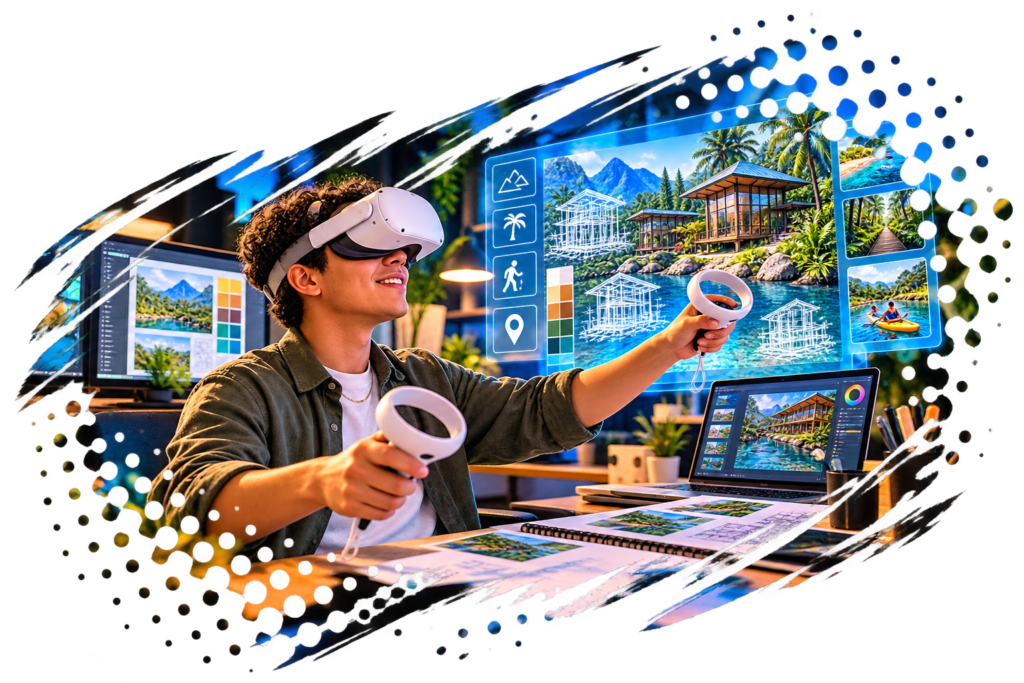
young male using vr
Wildcard Futures video title card

The Quick Take

What's Happening?

At Spartanburg Regional Healthcare System, VR rehab programs let patients take a virtual trip to the grocery store to practice walking, reaching, and grasping.

Why Now?

Affordable, all-in-one headsets
+
Hard-to-practice therapy
=
More opportunities to design VR around real treatment goals

What's Next?

In stroke rehab, researchers are testing the use of gentle electrical pulses patients can feel when they touch something in VR – helping the brain reconnect touch and movement.

Today’s Jobs → Tomorrow’s Career

Even future careers have a backstory. This one starts in therapy rooms and on the screens where virtual worlds are built.

Occupational Therapists

Focus: the real-life skills

Plans activities around what a patient needs to navigate everyday life

About $100k

Mental Health Counselors

Focus: the coping

Helps people develop healthier ways to respond to difficult thoughts, feelings, and situations

About $59k

Software Developers

Focus: the interaction

Builds the software that makes a virtual world respond to what the user does

About $136k

Imagine these jobs coming together. Then add a new challenge: turning a treatment goal into a something a patient can practice in VR.

Quick reality check: These are national median salaries for current jobs. That means half of workers earn more, and half earn less. They are not starting salaries or guaranteed pay for this emerging career. As you gain experience or continue your education, your pay may grow too.

What the work could look like

A Day Could Look Like This:

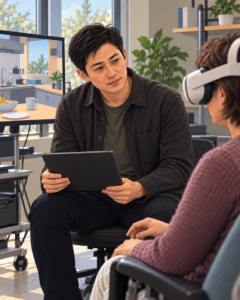
man holding tablet observing another person using VR headset8:30 AM — Breakfast earns a suspiciously perfect score. I want a closer look.
I’m testing a virtual kitchen with a patient recovering from a brain injury. Her task is to make a simple breakfast: toast the bread, spread the jam, pour the juice, and grab a banana. She finishes every step, and the program gives her a perfect score.

But every time she pauses, the item she should use next lights up. It’s an automatic hint built into the exercise, and I’m curious… spaced. 

9:15 AM — On the next round, I stop watching the score and start watching the patient’s pauses.
She looks around the kitchen. Before she chooses what comes next, the bread lights up. Later, the orange juice practically volunteers. The VR is following its instructions so well that the patient doesn’t have time to choose for herself what should come next.

10:20 AM — Time to rethink the hints and make some changes to the VR.
The occupational therapist explains that the patient needs practice working out the sequence independently – not racing through breakfast. Together, we look at when a hint would help and when the patient needs more time to think first.

Back at my computer, I adjust the virtual kitchen settings so the automatic glow waits longer and the first hint is less obvious. I also give the therapist a way to trigger more help when the patient needs it.

1:30 PM — We test breakfast again – this time, without the instant hints.
The patient pauses after getting a plate. No glow.

For the first time all morning, the kitchen waits.

A few seconds later, she scans the counter, chooses the bread, and keeps going. But after spreading the jam, she gets stuck. The therapist triggers a hint, and she reaches for the juice.

3:00 PM — Breakfast takes longer, but that’s actually good news.
The patient is working out more of the sequence on her own before the VR steps in. I save the new settings and mark where the therapist needs to help. That gives us a better sense of what the patient can work through independently – and where the kitchen still needs some adjusting.

Step Into the Role

The technology shouldn’t become the hardest part of therapy.

A patient is using VR to practice moving their arm after a stroke. But they have trouble using the hand controls, so they’re spending more effort operating the VR than practicing the movement.

What would you try first?

A. Make the VR respond to arm movements instead of button presses.

→

You prioritized the treatment goal.
B. Switch to a controller that's easier to hold.

→

You prioritized giving the patient more direct control.
C. Let the therapist handle some controls while the patient focuses on reaching.

→

You prioritized keeping the practice simple.
In real life, VR therapy designers watch where patients struggle with the technology and revise the experience so the controls don’t compete with the therapy.
One step further: How would you know whether your change made the controls easier without making the exercise itself too easy?

You might like this if you're...

The Peer Mentor

People come to you when they need to talk something through without feeling judged.

The Improviser

When plans change at the last minute, you’re already finding another way forward.

The Worldbuilder

You can picture a whole setting from one tiny detail.

The Psych Student

Phobias, memory tricks, weird habits – you want to know what the brain is doing and why.

How Your Classes Connect

What you're learning now How you'd use it in this career

MATH — Measuring distance and angles in three-dimensional space

To adjust how far or high a patient needs to move in VR

SCIENCE — How the brain and nervous system control movement

To design VR exercises that target the movement a patient needs to practice

PSYCHOLOGY — How fear and anxiety affect the way people respond

To balance challenge and comfort as a patient practices in VR

COMPUTER SCIENCE — How programs respond to user input

To make a virtual world react when someone moves or uses a controller

Make Your Move

There’s no single portal into this emerging career.

Start at a South Carolina technical college

Choose the part of the work that interests you most.

The Patient Care

The Virtual World

The User Experience

Add to your toolkit

Want to make a virtual world do more than just look cool? Unity’s Certified User: VR Developer is an optional certification that shows you know the core skills behind building interactive VR projects.

Explore a four-year option

An advisor can help you choose courses that could count toward a four-year college or university in fields like computer science, media arts, exercise science, or psychology.