




Next-Gen Health

Medical Illustrator

paint palette and acting mask

Arts, Entertainment, & Design

heart rate graph

Healthcare & Human Services

How can we rethink healthcare?

By changing how we understand health.

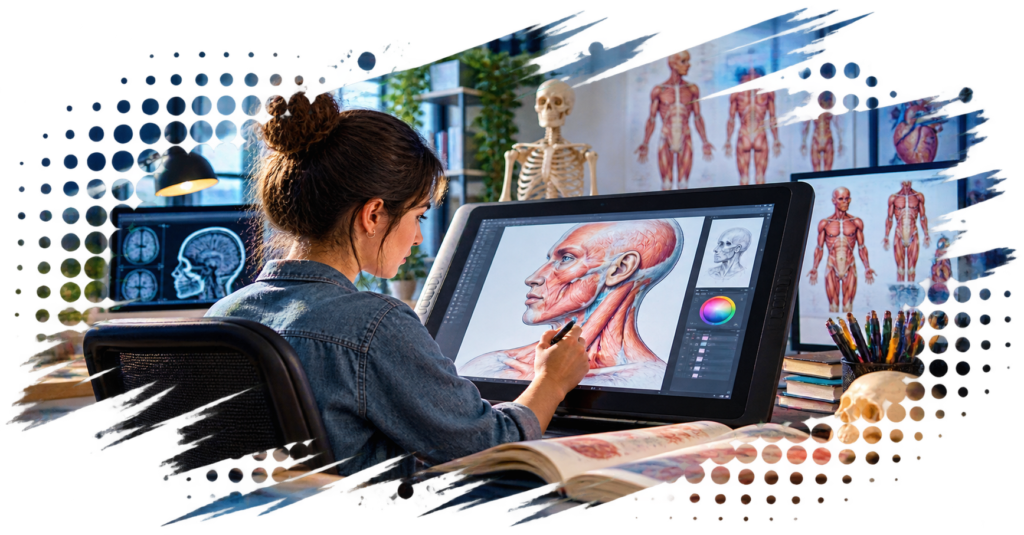
Medical illustrators study the body, then create visuals that help people understand what doctors and scientists see. Their work can show what’s happening beneath the skin, even when a camera can’t.
Wildcard Futures video title card

The Quick Take

What's Happening?

Across South Carolina, colleges are using Anatomage tables, virtual cadavers that let students peel back layers of the body and explore anatomy in 3D.

Why Now?

More complex medical treatments
+
Better interactive tools
=
New ways to show patients what’s happening inside their bodies

What's Next?

AI is getting better at creating medical images, but anatomical accuracy still depends on human expertise to decide what to show, how to show it, and which details matter.

Today’s Jobs → Tomorrow’s Career

Even future careers have a backstory. The building blocks for this one are already at work in art and animation studios and medical research labs.

Fine Artists (Painters, Sculptors, & Illustrators)

Focus: the illustration

Creates detailed, accurate artwork that makes an idea or reference visible

About $55k

Special Effects Artists and Animators

Focus: the motion

Builds 2D and 3D models and animation that show how something moves or works

About $102k

Medical Scientists

Focus: the biology

Studies disease and treatment to understand what’s happening inside the body

About $103k

Imagine these jobs coming together. Then make every creative choice answer to the science.

Quick reality check: These are national median salaries for current jobs. That means half of workers earn more, and half earn less. They are not starting salaries or guaranteed pay for this emerging career. As you gain experience or continue your education, your pay may grow too.

What the work could look like

A Day Could Look Like This:

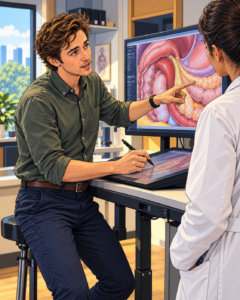
male pointing at computer screen and sketching8:35 AM — I make the appendix easy to find. Maybe too easy.
I’m creating a teaching illustration that shows how to surgically remove an appendix using a tiny camera inside the abdomen. When I finish, the appendix on my screen sits neatly beside the large intestine, with plenty of room to see what’s around it.

Hmm… before I go any further, I think I should get a second opinion.

9:20 AM — The surgeon sees things differently.
She reviews the draft and points out that her view during surgery is much tighter. From the camera’s angle, some structures overlap and partly hide the appendix. I ask what she sees first and which landmarks help her locate the appendix.

10:40 AM — Back at my desk, it’s time to fix the point of view.
I compare anatomy references, the surgeon’s notes, and images from the procedure. I trace where the appendix connects and what should appear in front of or behind it.

12:30 PM — I turn, tilt, zoom, and shift. Still not right.
(Sigh.) It’s starting to feel like I’m taking a group photo where everyone has to squeeze in without blocking anyone else. And we know how that can go.

With a few more tweaks, an angle starts to work.

1:50 PM — I understand where my first attempt went wrong.
From this position, I can see which structures compete for attention. Without simplifying what the surgeon would actually see, I adjust the framing, lighting, and depth so the appendix is easier to identify.

3:40 PM — I put the revised view back in front of the surgeon.
This time, it matches what she expects to see. We flag a few smaller details for another pass, then she moves on to the next step of the procedure, and I head back to my desk with a much shorter to-do list – and a little more bounce in my step.

Step Into the Role

Sometimes showing everything makes it harder to see what matters.

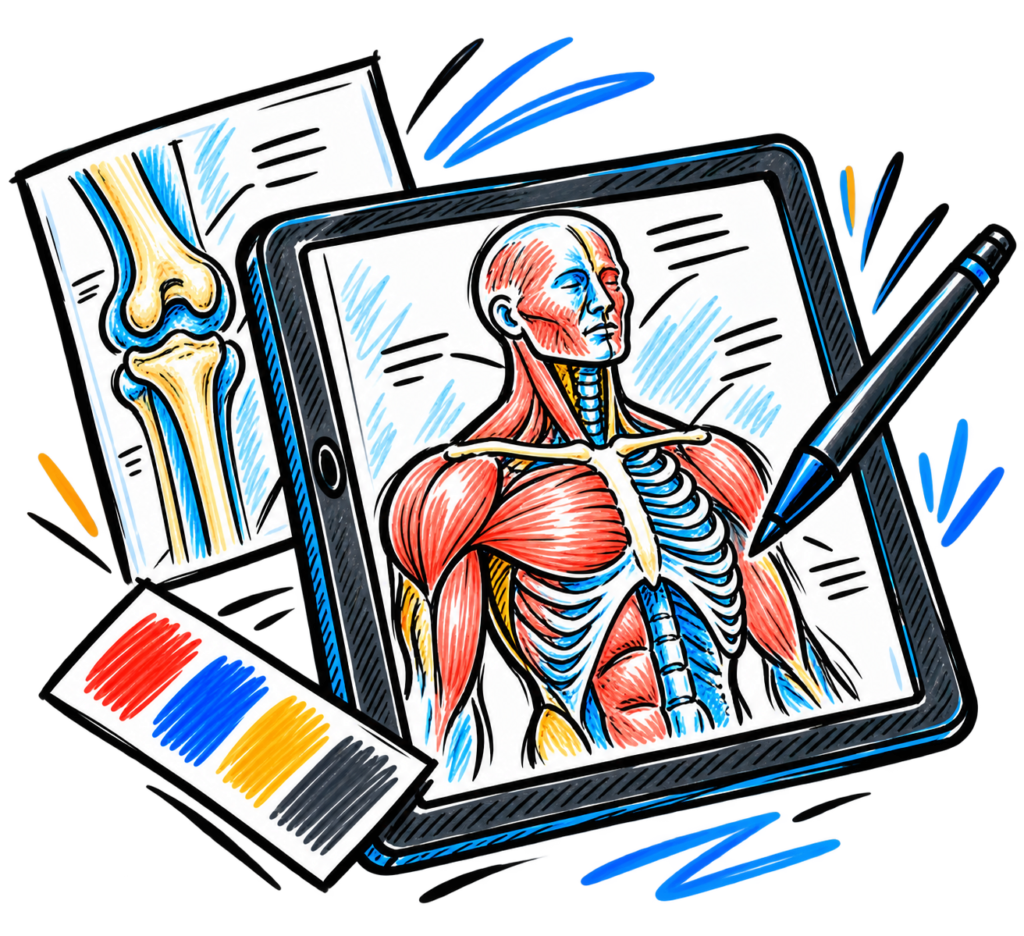
You’re creating an animation for patients that shows how a torn knee ligament is repaired during surgery. The surgeon wants the surrounding anatomy shown accurately, but showing all of it at once is getting crowded and harder for patients to follow.

How would you design the animation?

A. Keep all the surrounding anatomy visible.

More detail, but a busier view →

You prioritized completeness.
B. Fade structures that aren't central to the repair.

Cleaner view, but less surrounding anatomy →

You prioritized clarity.
C. Start simple, then add more anatomy as the animation moves forward.

More steps, but easier to follow over time →

You prioritized a step-by-step explanation.
In real life, medical illustrators work with healthcare experts to decide what must stay anatomically accurate, what can be simplified, and what the audience needs to understand.
One step further: What would you change if the same animation were being made for medical students instead of patients?

You might like this if you're...

The Artist

A blank page won’t stay that way for long; your doodles have a way of taking over.

The Eagle Eye

You notice the smallest background details before anyone posts the group photo.

The Explainer

When someone looks confused, you can find a better way to make the idea click.

The Photographer

You’ll crouch, climb, or move three steps over to find the angle everyone else missed.

How Your Classes Connect

medical drawing on tablet
What you're learning now How you'd use it in this career

MATH — Using ratios and measurements to compare size and distance

To keep body parts in proportion when a visual is enlarged, reduced, or built in 3D

SCIENCE — How body systems connect and affect one another

To show how an injury or treatment changes what’s happening inside the body

ENGLISH — Distinguishing the main idea from supporting details

To decide what a viewer needs to see and what can stay in the background

ART — Perspective, proportion, and how light and shading create form

To make anatomy look accurate and believable from different angles

Make Your Move

There’s more than one way to draw a path into this emerging career.

Start at a South Carolina technical college

Choose the part of the work that interests you most.

The Art

The Digital Creation

The Body + Science

Add to your toolkit

Interested in the digital-art side? Adobe Certified Professional in Illustrator is an optional credential that can show you know your way around professional illustration software. Later, practicing medical illustrators may choose to earn the Certified Medical Illustrator credential.

Explore a four-year option

An advisor can help you choose courses that could count toward a four-year college or university in fields like graphic design and illustration or biology with art coursework – often preparation for graduate study in medical illustration.