





Wildcard Futures

People First

Bioethicist

heart rate graph

Healthcare & Human Services

government building

Public Service & Safety

How can we make choices with people in mind?

By weighing the human impact of medical decisions.

Bioethicists help patients, families, and medical teams untangle the difficult choices that come with new treatments and technologies – because in medicine, even good news can raise hard questions.
young female working at computer

The Quick Take

What's Happening?

Over 50,000 adults across our state have completed genetic screening through MUSC’s In Our DNA SC project – and a committee reviews how researchers may use their genetic data.

Why Now?

Once-experimental treatments becoming real options
+
No easy answers
=
A greater need for people who can see every side

What's Next?

Doctors are testing gene-edited pig kidneys in people – and bioethicists will help shape what happens when animal organs become a real treatment option.

Today’s Jobs → Tomorrow’s Career

Even future careers have a backstory. The building blocks for this one are already at work in labs, hospitals, and the rooms where healthcare decisions are being made.

Medical Scientist

Focus: the science

Studies disease and tests new treatments to show what science can – and can’t – tell us

About $103k

Compliance Officer

Focus: the protections

Makes sure healthcare organizations follow laws and respect patients’ rights

About $81k

Medical & Health Services Manager

Focus: the impact

Plans how changes in healthcare will affect patients and care teams

About $124k

Imagine these jobs coming together. Then add a medical breakthrough – and a brand-new question.

Quick reality check: These are national median salaries for current jobs. That means half of workers earn more, and half earn less. They are not starting salaries or guaranteed pay for this emerging career. As you gain experience or continue your education, your pay may grow too.

What the work could look like

A Day Could Look Like This:

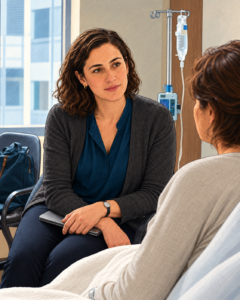
woman listening to patient8:15 AM — The request comes in.
A nurse calls about a patient who wants to leave before her treatment is finished. The medical team recommends two more days of IV medicine and monitoring. The patient has packed her bag.

9:00 AM — The chart only tells part of the story.
I review the medical facts and ask the physician what could happen if she leaves.

Then I meet the patient, who understands the risk – and has named her IV pole Ivy after three days together. She explains that she is the main caregiver for her father, who cannot safely stay alone. A neighbor is helping for now, but has to leave tonight.

Six pages of medical notes. No mention of that.

10:15 AM — I reframe the question.
The team has been asking, “How do we convince her to stay?” Staying could protect her health, but it could also leave her father without care.

So I ask, “How can we reduce both risks?”

11:30 AM — I bring the patient, physician, and case manager together.
I guide the conversation so everyone has a chance to share their concerns. Together, we look for a way to protect both the patient and her father.

2:00 PM — We have a plan for tonight.
The case manager arranges for someone to stay with her father overnight. The patient agrees to stay at the hospital, while the physician explores treatment options closer to home.

Her bag remains packed. Ivy gets another lap down the hall.

3:15 PM — I document what we agreed to.
The final treatment plan isn’t settled, but the patient’s father will not be alone tonight – and she can make the next decision with all the options in front of her.

Step Into the Role

An early warning tool could save a life – but what if it works better for adults than teens?

You’re helping a hospital review an AI tool that warns doctors when a patient may be getting dangerously sick. Tests show it catches problems earlier in adults but misses more warning signs in teens.

What should the hospital do?

A. Use it for everyone, with doctors double-checking its alerts.

→

You prioritized faster access.
B. Start with adults while researchers gather better information about teens.

→

You prioritized stronger evidence.
C. Wait until testing shows the tool works just as reliably for teens.

→

You prioritized fairness and accuracy.
In real life, bioethicists help medical teams understand tradeoffs like these before deciding what to do.
One step further: What should patients know before AI becomes part of their care?

You might like this if you're...

The Deep Thinker

One yes-or-no question sends your brain toward five possible answers.

The Debater

You can argue either side of a “would you rather?” question and make both sound convincing.

The Peacekeeper

When the group chat catches fire, you know how to cool things down.

The Referee

You care more about a fair call than whether your side wins.

How Your Classes Connect

What you're learning now How you'd use it in this career

MATH — Probability, percentages, and reading charts and graphs

To compare how likely a treatment is to help – or cause serious side effects

SCIENCE — Genetics, body systems, and the scientific method

To understand how a new treatment works and what researchers still need to test

ENGLISH — Supporting an argument with evidence

To guide a conversation when a family and a medical team disagree about what to do

SOCIAL STUDIES — Rights, laws, and how policies affect communitites

To identify who gets a voice when healthcare rules are written

Make Your Move

There’s no single right answer in bioethics – and no single route into the career.

Start at a South Carolina technical college

Choose the part of the work that interests you most.

Care for People

Science

Law + Rights

Add to your toolkit

Human Subjects Research training through the CITI Program shows you how researchers protect people who volunteer for studies. If you help with a college or hospital research study, you may need this training before working with volunteers or seeing their health information.

Explore a four-year option

An advisor can help you choose courses that could count toward a four-year college or university in fields like biology, public health, or healthcare administration.