




People First

Accessible Experience Designer

paint palette and acting mask

Arts, Entertainment, & Design

suitcase and globe

Hospitality, Events, & Tourism

How can we make choices with people in mind?

By removing barriers so more people are included.

Accessible experience designers help event teams create places more people can use comfortably and independently. On opening night, they may learn more by observing a doorway than by watching the stage.
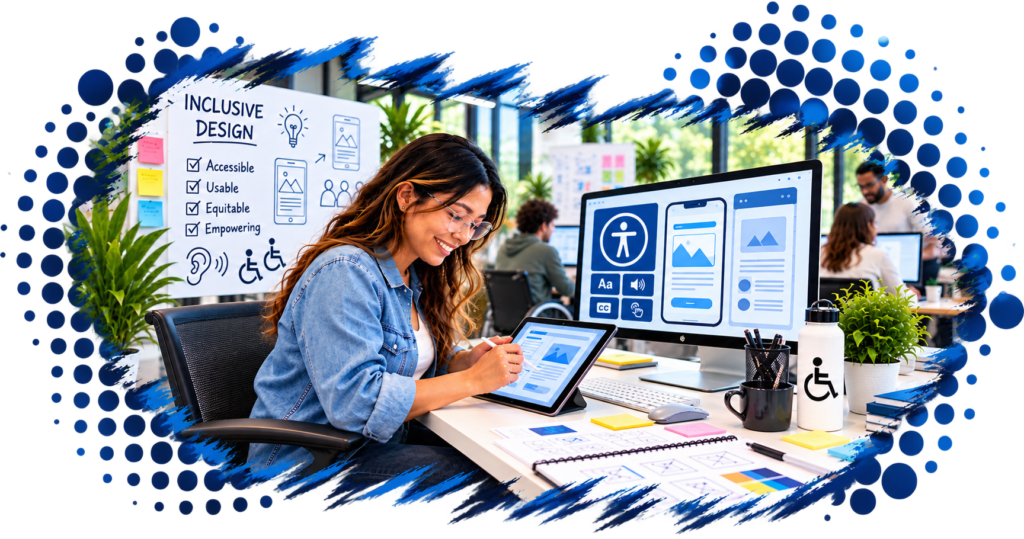
young female working at computer
Wildcard Futures video title card

The Quick Take

What's Happening?

All nine South Carolina Welcome Centers now have quiet spaces and packets with sunglasses and earplugs so that sensory-sensitive travelers feel welcomed.

Why Now?

More public services moving online
+
New rules for government websites and apps
=
Accessibility must work on screens, not just in buildings

What's Next?

Blind and low-vision fans can now follow live football, basketball, and baseball games through touch technology – at venues or at home – and more sports are expected to follow.

Today’s Jobs → Tomorrow’s Career

Even future careers have a backstory. Look closely, and you’ll find this work already happening wherever people gather for an experience.

Meeting, Convention, and Event Planners

Focus: the event

Coordinates behind-the-scenes planning so that an event runs smoothly for guests

About $61k

Web & Digital Interface Designers

Focus: the screen

Builds clear paths through websites and apps, then tests whether they work

About $104k

Interior Designers

Focus: the physical space

Plans layouts that make indoor spaces easier to navigate and use

About $67k

Imagine these jobs coming together. Then add feedback from disabled people so that the experience works for the people it’s meant to welcome.

Quick reality check: These are national median salaries for current jobs. That means half of workers earn more, and half earn less. They are not starting salaries or guaranteed pay for this emerging career. As you gain experience or continue your education, your pay may grow too.

What the work could look like

A Day Could Look Like This:

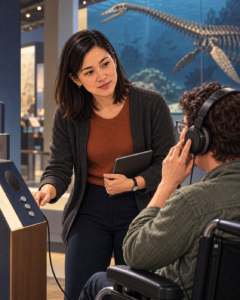
woman helping young male in wheelchair with headphones8:30 AM — The exhibit sounds ready.
We’re testing a new prehistoric ocean exhibit before it opens. One station uses audio to describe a life-size model of a plesiosaur. In the quiet gallery, everything works the way we planned.

9:40 AM — Then the museum gets museum-y.
A disabled tester tries the station while a small group of preview visitors moves through the gallery. Conversations bounce off the walls. A nearby interactive starts making noise. Somewhere, a child discovers a button that apparently deserves 14 presses.

The audio is suddenly much harder to follow.

10:15 AM — What’s getting in my way?
Instead of assuming the audio itself is the problem, I ask the tester where the experience became difficult.

We walk through it again. I pay close attention to the sounds and activity around us.

11:30 AM — The audio isn’t the problem.
Back in the quiet gallery, the recording is clear. Add visitors and the nearby interactive, and the audio gets buried.

I share what we found and recommend a few changes. The exhibit team moves the listening station farther from the noisiest part of the gallery, and the AV team adjusts the sound settings.

1:45 PM — We test the revised station.
The gallery is busy again. I’m checking whether the audio works. But I’m also watching whether the tester can follow the experience comfortably, know what to do next, and use the station without extra help.

3:10 PM — Not finished, but definitely better.
The second test goes more smoothly. I document what improved and what we still need to test with other users before opening.

That’s progress for today. Tomorrow, I’ll tackle the fossil-reconstruction puzzle. (Turns out, prehistoric oceans come with a pretty long to-do list.)

Step Into the Role

A map can be correct and still leave people lost.

A county fair moves to a bigger park. During a test visit, disabled guests say the route from parking to the stages is hard to follow. The signs meet basic requirements, but the budget allows one major upgrade before opening day.

What would you improve first?

A. Replace the signs with larger ones using plain words and clear symbols.

→

You prioritized guidance that works without a device.
B. Add a mobile map with directions guests can read or hear one turn at a time.

→

You prioritized personal guidance throughout the visit.
C. Put trained guides at the busiest turns.

→

You prioritized flexible help from a real person.
In real life, accessible experience designers would test the route with disabled guests and try not to make access depend on one sign, one screen, or one staff member.
One step further: What barrier might exist even with your improvement – and what could you add to make your choice work for even more visitors?

You might like this if you're...

The Optimist

You’re a glass-half-full person who sees possibilities and helps others see them, too.

The Good Listener

You know whether a friend wants advice or just needs room to talk.

The Advocate

You speak up when someone is being bullied or ignored.

The Fun One

You keep everyone entertained – special occasion or not.

How Your Classes Connect

accessibility options on screen
What you're learning now How you'd use it in this career

MATH — Using measurements and scale to calculate distance and size

To compare routes and check whether guests have enough room to move

ART — Using color, contrast, and layout to guide someone’s attention

To make maps, signs, and screens easier for guests to see and follow

ENGLISH — Writing clear directions with a specific audience in mind

To help guests know where to go and quickly understand event updates

SOCIAL STUDIES — Learning how laws shape people’s rights in public spaces

To understand access rules and consider how an event plan affects different people

Make Your Move

A career built around access should have more than one way in.

Start at a South Carolina technical college

Choose the part of the work that interests you most.

The Event

The Screen

The Space

Add to your toolkit

If screens interest you, Digital Accessibility Foundations is built for students and digital creators. If the guest experience is more your thing, At Your Service offers practical ways to welcome disabled customers. Both are optional – not job requirements.

Explore a four-year option

An advisor can help you choose courses that could count toward a four-year college or university in fields like architecture, interior design, digital design, or hospitality/tourism management.